$20 Minimum Wage
The Problem: Rising Prices and Artificially Depressed Wages are Driving the Affordability Crisis
Wisconsin’s minimum wage of $7.25 has not increased in decades and long before that failed to reflect a living wage. As wages for working people have flatlined the gains of economic growth have been skimmed off by the wealthy in the form of massive corporate profits, producing record levels of economic inequality. According to Oxfam over the last 30 years U.S. households in the top 1 percent gained at least 101 times more wealth than the average household. Because of the excess profits stolen from working people, the stock market is skyrocketing to new records, and luxury yachts are one of the fastest growing consumer products.
For the rest of us, the affordability crisis is caused by a double whammy of artificially depressed wages and skyrocketing cost of essentials, such as health care, housing, utilities, groceries, and everything else we need to thrive. The cost of living in every Wisconsin county is 3xs the minimum wage, making it impossible for many workers to afford the basics of life.
There are 800,000 Wisconsin workers who make less than $20/hour, 30% of workers, and yet in every area of Wisconsin the living wage, the amount needed to afford the basics of life, is over $21 per hour for a single person!
Many people who make above the living wage also have trouble making ends meet and getting ahead because their wages are also depressed by the artificially low wage floor in Wisconsin. When the minimum wage is increased all boats are lifted.
The Cause: The Power of Corporations and the Wealthy
The stagnant minimum wage is not an accident, it is not natural, it is a sign of the corruption of our democracy. The economy has been rigged against working people to benefit the wealthy and the powerful through the lobbying and political might of exploitative employers like fast food chains and big box stores, and big corporate lobbying interests like Wisconsin Manufactures and Commerce (WMC).
Their voices are heard more loudly than the people at the State Capitol. Democracy is broken when elected officials act on behalf of powerful economic interests rather than the people they are sworn to represent.
As a result, working people have lost their bargaining power in the economy. Without a reasonable minimum wage, and with few unions (due to rampant legalized union busting), workers are left at the mercy of the greedy and the powerful.
Solution: A $20 Minimum Wage
Politicians promise good jobs all the time, but most of what they propose has little if any impact for most workers. Throwing tax breaks at big corporations in the name of so-called “economic development” does nothing to address the affordability crisis.
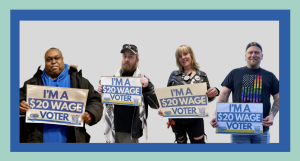
The simplest and most effective solution that lifts all boats and makes work pay is to raise the minimum wage to $20 an hour. This is what a $15 minimum wage is worth now, after inflation, since the idea was first proposed ten years ago.
A $20 minimum wage will create jobs and more prosperity in every Wisconsin community. When corporations take more than their share, they extract money (and jobs) from our communities, investing anywhere they can make the most profit and buying more status symbols like vacation homes and luxury yachts. When typical Wisconsinites make a living wage, they spend it on essentials, such as groceries, child care, school supplies, rent, and long term care for our elders, employing more people and making our communities thrive. This especially helps small businesses throughout Wisconsin and their workers, because they provide goods and services to the working and middle class.
The State Legislature and the Governor have this power, but they will not do it without irresistible public pressure. Only organized people can defeat organized money. The only way this can happen is if enough people get involved, and raise the voice of working people loud enough to overwhelm the corporate lobbyists that infest and corrupt our State Capitol.
